
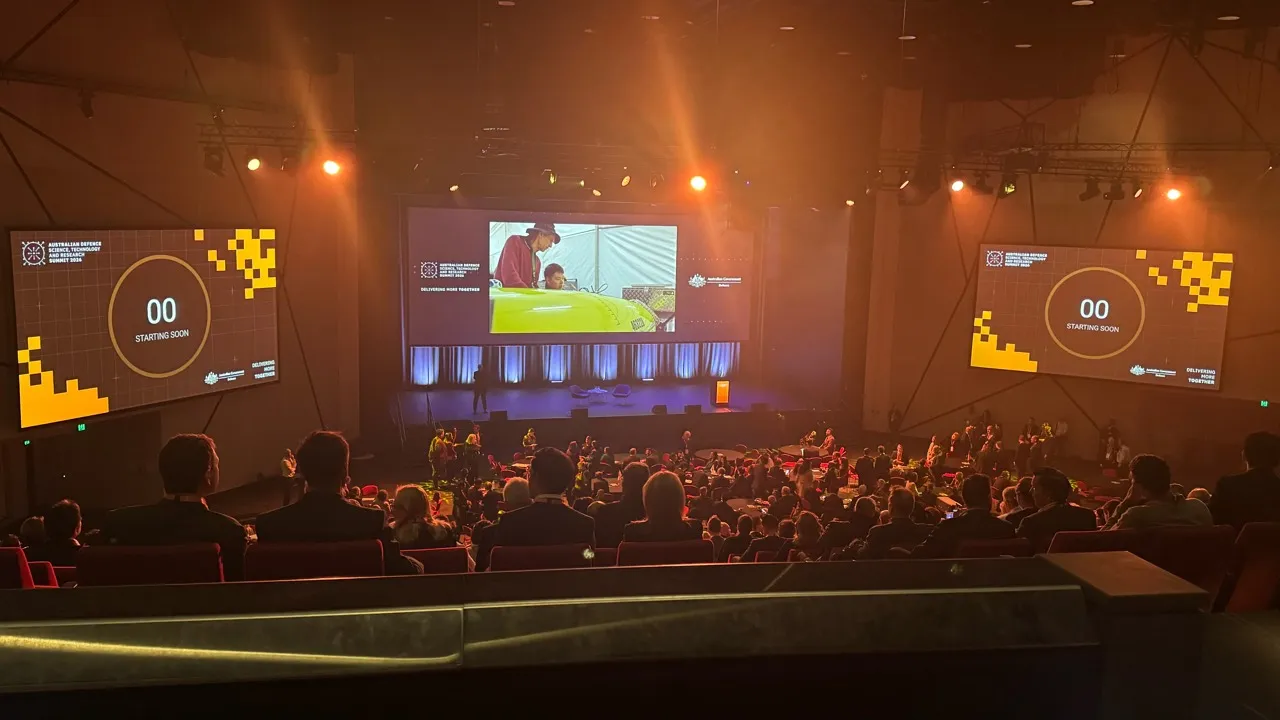
We went to ADSTAR Summit 2026 to understand the Defence innovation, science and technology ecosystem and where our forensic research might contribute. We came home with a different understanding of how useful technology becomes operational capability.
RHEM Labs’ commercial foundation is forensic examination and expert evidence. That work funds applied research into problems we encounter in practice. SPOT—Sensor Pattern Origin Testing—emerged from that model, through research into digital image formation, sensor behaviour and the interpretation of image-origin evidence.
Before ADSTAR, we had largely assumed that a national-security problem as visible as synthetic media must already be addressed by capabilities substantially more mature than anything a small civilian forensic laboratory could offer. The Summit challenged that assumption about how the system works.
A recognised problem still needs an owner
The recurring question at ADSTAR concerned integrated capability: where does a technology fit, who owns the problem, and how does it become useful in an operational setting?
Recognising a strategic problem, funding research and having promising technology somewhere in the Australian ecosystem are distinct from putting a capability into the hands of an analyst or operator. The connections between those stages have to be made.
A mission need requires an owner. A programme needs a way to test and mature the proposed contribution. Integration, assurance, funding and sustainment all affect whether that contribution can be used. A working prototype can sit outside those arrangements even when its underlying science is relevant.
That changed the question we were asking of SPOT. We need to identify the decision it could inform, the information required for that decision, and the experiment that would establish whether its contribution is useful.
The forensic contribution
SPOT examines the statistical behaviour of image-noise residues to evaluate competing origin hypotheses. Its current research concerns whether image characteristics are more consistent with physical camera capture or synthetic generation.
This is a narrow forensic question within a much larger information problem. Origin assessment does not establish the truth of a depicted scene or determine the intention behind it. A physical camera can capture a synthetic image displayed on a screen. Other evidence and analytical judgement remain necessary.
The published research and experimental results provide a basis for further testing. They do not establish performance on an operational imagery population or demonstrate a Defence effect.
One possible application is triage. Image-origin information might help an analyst decide which material warrants specialist examination and where limited attention should be directed. The relevant measures would include uncertainty, analyst effort, missed or incorrect flags and the time needed to reach a useful conclusion. Those effects require evaluation in context.
Start with the smallest useful contribution
The idea of minimum viable capability aligns with our engineering approach: define the problem, do the science and avoid adding complexity without a reason.
A capability does not need to resolve every question about synthetic media before it can be worth experimenting with. It does need a defined purpose, understood limits and evidence that it can meet the requirement for that purpose.
For SPOT, that means examining whether a limited origin-assessment function could contribute to an existing workflow alongside provenance metadata, conventional image forensics, other sensors and analyst judgement. The question is what the combined system enables its users to do.
The next experiment belongs in context
Further development needs representative imagery and people who understand the intended workflow. Compression, resizing, screenshots, recapture, unfamiliar generators, hybrid imagery and deliberate transformations may all affect the evidence available for interpretation.
Testing must expose failures as well as successes. Where does the method become unreliable or inconclusive? Does the difficulty arise from an engineering choice, a mismatch with the intended population or a scientific limitation? What complementary examination is needed?
The development loop is experiment → observe → understand → adapt → retest. Operational experience should continue to generate research questions after an initial capability is introduced. An enduring contribution depends on that feedback, because the imagery, processing pipelines and ways of using the results will change.
Our wider research direction separates origin, zoning and transposition: how an image came into existence, whether different regions have different generative histories, and how transformations alter or obscure the available evidence. SPOT addresses one part of this programme.
Making sovereign expertise discoverable
ADSTAR also sharpened a question about discovery. A specialist capability may exist before the people responsible for a mission know to look for it. Explaining enough to establish relevance is part of our responsibility as a laboratory.
There is a tension to manage. Public communication can make a capability discoverable while also exposing information that helps others reproduce or counter it. The practical challenge is to explain the problem, contribution and evidence clearly, then establish appropriate arrangements for more detailed technical engagement.
For Australia, a sovereign contribution can be a specialised method, component or body of expertise within a larger system. SPOT builds on international sensor-pattern research and Australian expertise in signal processing and forensic image provenance. Retaining the knowledge and capacity to understand, adapt and evaluate such methods matters alongside ownership of the implementation.
Where the laboratory goes next
The work ahead begins with mission problem → operational effect → decision → information requirement → experiment → capability contribution. A relevant problem owner and representative evaluation matter more than assuming that a particular market needs the prototype in its current form.
There are organisational and commercial questions too: who can provide integration and assurance, how the work could be sustained, and who carries the cost and risk of transition. These need to be resolved alongside the technical experiment.
RHEM Labs remains an independent forensic science laboratory and expert witness practice. ADSTAR helped us understand how specialist research from that practice could contribute to a wider Defence capability system, and what must be learned before that possibility becomes something an operator can rely on.
Explore the proposed SPOT Defence evaluation pathway, read our AIPIO laboratory update, or discuss a research or evaluation question. Initial enquiries should be unclassified and non-sensitive.