

RHEM Labs attended AIPIO Intelligence 2026 in Melbourne with a question: where can forensic information about the origin of digital imagery help someone make a better-informed decision?
We deliberately took that question beyond the digital-forensics conference environment. Intelligence practitioners work with information from different sources, under time constraints, and with consequences attached to both acting and waiting. Understanding where forensic science can assist that work requires engagement with the people making those judgements.
We attended as a laboratory, bringing SPOT—Sensor Pattern Origin Testing—as a research-derived prototype. AIPIO was an opportunity to make the capability visible to a broader professional community and explain how our forensic work could support intelligence and investigative practice.
The question we brought
Our conference handout asked: “Can we establish confidence in the origin of digital media before it informs decisions?”
SPOT examines measurable characteristics associated with image formation and sensor behaviour. It evaluates the strength of support for competing origin hypotheses, including whether an image’s statistical characteristics are more consistent with physical camera capture or synthetic generation.
That is a specific contribution to understanding an image. A finding about origin does not establish that the depicted scene is true, explain the creator’s intention or replace an assessment of the source. A camera can, for example, photograph a display showing synthetic imagery. The physical capture process and the provenance of what it depicts are different questions.
The handout set out three application domains: Defence and intelligence; law enforcement and investigators; and regulators and financial institutions. Each may encounter imagery whose origin matters to a decision. The consequences, required confidence and appropriate response will differ.
It also stated the development position plainly. Foundational research, prototype development and experimental evaluation had taken SPOT to a point where further progress required input from operational users, representative testing and co-design.
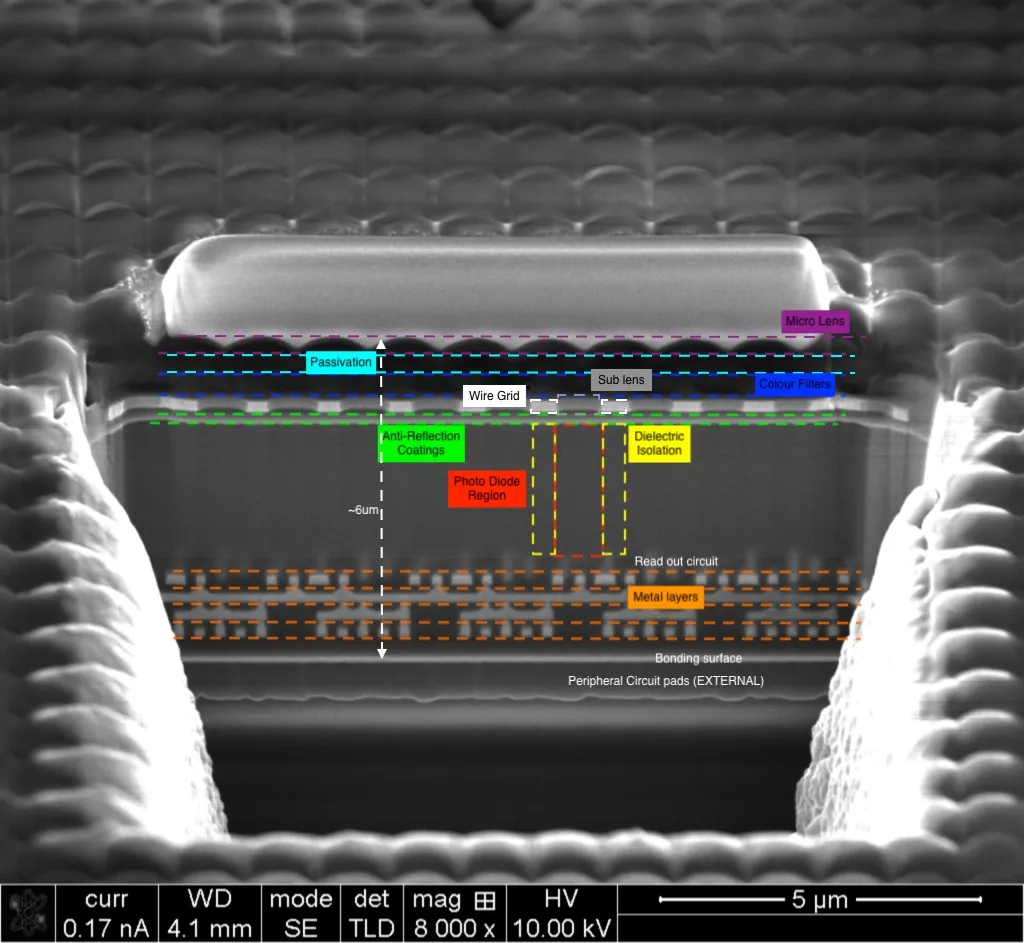
Physical image formation underpins the research behind SPOT. Sony IMX219PQ sensor cross-section from Richard Matthews’s 2019 doctoral thesis, Figure 5.2, p. 61. Read the thesis record.
Anticipation, not only speed
A recurring theme at AIPIO was the pressure to shorten information cycles. AI can reduce the time and effort needed to create and distribute deceptive material, leaving analysts with more information to assess and less time in which to assess it.
Our response was to ask what happens if the emphasis falls entirely on moving faster. Intelligence also exists to anticipate: to recognise what is developing before it becomes the problem everyone is responding to. Accelerating an existing process is useful only if that process supplies the information needed for a sound decision.
For the laboratory, that brings the timing of forensic examination into focus. Can information about origin be available early enough to shape an assessment, influence collection or identify material requiring closer scrutiny? Where might it help an analyst decide what to examine next?
SPOT offers a specific proposition to investigate in that setting. Its experimental foundation concerns image origin. Whether that information improves anticipation, prioritisation or decision-making depends on the workflow, the reliability of the result under relevant conditions and how uncertainty is communicated.
AIPIO made the work visible beyond our usual digital-forensics network and gave us a clearer context in which to explain its possible contribution. The handout already called for co-design and representative evaluation. The conference sharpened the reason for that work: understanding which decision the forensic information could improve, and when it would need to arrive. Establishing that effect remains the task of operational evaluation.
Supporting intelligence through forensic science
RHEM Labs’ commercial foundation remains independent forensic examination and expert evidence. That practice requires us to distinguish observations from inferences, examine how a digital record was created and explain the limits of a conclusion. The same discipline can supply useful information to intelligence and investigative decisions.
For Defence and intelligence, image-origin assessment could contribute to information resilience by helping analysts assess material before relying on it. It could also make some forms of synthetic-media deception more costly or less effective. These are potential effects to investigate, not outcomes established by the prototype’s experimental results.
For law enforcement and investigators, the application is evidence assurance: additional scientific information about questioned imagery, expressed through an evaluative framework. A binary “real” or “fake” label can conceal the hypotheses, uncertainty and limitations that an investigator or court needs to understand.
Regulatory and financial investigations raise related questions when imagery supports a claim, transaction or allegation. Across these settings, forensic origin assessment would sit alongside provenance records, other technical examinations and professional judgement.
The next phase
The next phase needs to establish where SPOT’s information is useful in practice and whether it arrives early enough to influence a decision. That means beginning with the decision, the imagery encountered and the consequences of error, then designing an experiment around them.
Representative evaluation must include processing histories such as compression, resizing, screenshots and recapture. It also needs to examine unfamiliar image sources, mixed provenance and cases in which the method cannot support a useful conclusion. Testing should measure what changes for the user: whether uncertainty is reduced, relevant material is identified sooner, or specialist attention is better directed.
This work sits within a broader forensic research programme. Origin asks how an image came into existence. Zoning asks whether different regions have different generative histories. Transposition examines how processing and transformation alter the evidence available for interpretation. SPOT addresses part of that programme; the other questions remain important to its eventual use.
Our model remains grounded in forensic practice. Professional work funds research into unresolved problems; research produces methods that must be tested before they can be relied upon. Australian expertise and intellectual property can contribute a specialised component to a larger analytical system without requiring the laboratory to supply every part of it.
AIPIO helped make that contribution visible. Our next task is to establish, with the people who would use it, where the science can provide useful information and what evidence is needed to justify its use.
Explore SPOT’s research and experimental evidence or contact RHEM Labs about research and evaluation.